Digital methods and software for physics
In the next years, an unprecedented amount of data will be produced in both the scientific field and the industrial economic system, so we will face the challenge of extracting value from this explosion of data. In this context, supercomputing, numerical simulation, artificial intelligence, high-performance data analysis, and big data management will be essential and strategic for understanding and responding to major societal challenges and for stimulating economic growth, enabling academia and industry to develop services and discoveries. This activity cuts across all fields of physics and transcends their boundaries, promoting a multidisciplinary approach to the "societal challenges" summarized by the sustainable development goals of the "2030 Agenda for Sustainable Development." It aims to develop the Knowledge Triangle through: the creation of sustainable digital infrastructures for research; the adoption of methodologies and services for the analysis of "big data," now common in various areas of physics, as well as in other fields, including industrial and social ones; The promotion of "challenge-driven education" in both university curricula and external training programs. Some research activities conducted specifically at the DFA on the development of machine learning and big data analysis techniques and their applications to physics and other scientific fields are briefly discussed below.
Research and development of new supervised and unsupervised machine learning techniques
Faculty: Marco Russo
This research line focuses on developing innovative machine learning techniques, with a focus on modeling and clustering. The main techniques investigated include Genetic Programming, Evolutionary Algorithms, Neural Networks, Clustering, and Fuzzy Logic. Among the numerous techniques developed, the Brain Project, ELBG, FuGeNeSys, FACS, GEFREX, PAUL, and LBGS are noteworthy.
Machine Learning Applications
Faculty: Marco Russo
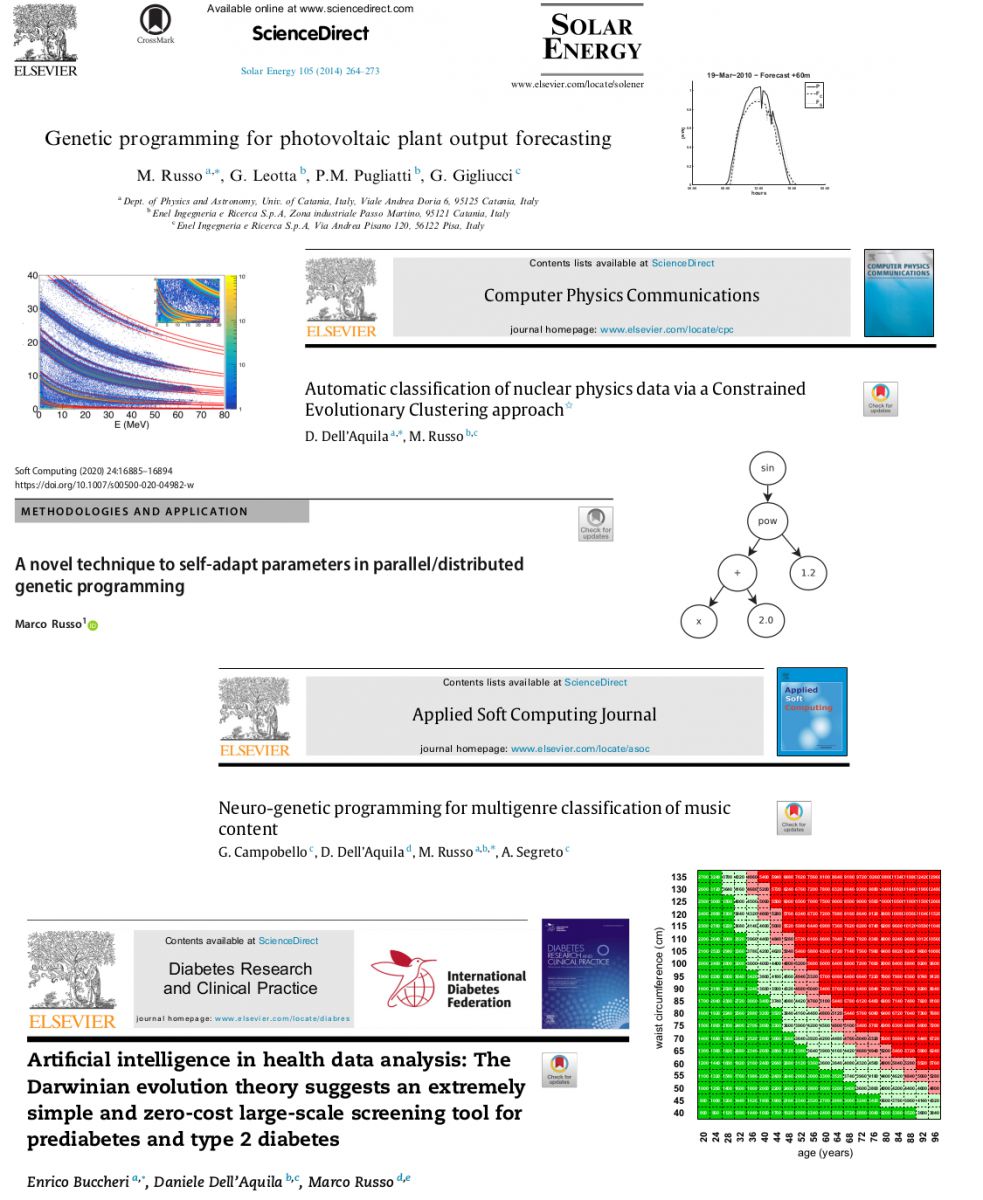
This research area aims to apply machine learning to develop new data analysis techniques for various fields, with a particular focus on physics. The group's areas of interest include:
- Study of the morphology and dimensions of nanostructures
- Classification in nuclear physics experiments
- Real-time gravitation wave detection
- Mathematical modeling in solar power forecasting
- Classifiers and screening tools in medicine
Big data analysis, parallel and/or distributed computing, and code optimization
Faculty: Marco Russo
This area of study focuses primarily on the analysis, modeling, and filtering of big data. Sub-areas investigated at the Department include both computation performed on multiple cores of the same CPU and the more complex computation involving distributed computation across multiple processors. This research area also pays particular attention to the procedures required for code optimization.