
Experimental astroparticle physics
The research activity in this field of Physics aims at the experimental study of the radiation and the particles of the cosmos with experiments conducted in surface, underground or undersea laboratories. The research groups of the Department of Physics and Astronomy are involved in several experiments of great interest that take place in Italy and abroad and with lines of research in applied physics on tomography with cosmic muons.
Dark matter: DARKSIDE
 There is a wide range of astronomical evidence that the visible stars and gas in all galaxies—including our own—are immersed in a much larger cloud of non-luminous matter, which typically contains significantly greater amounts of mass. The nature of this non-baryonic component remains entirely unknown, and resolving the "dark matter puzzle" (DM) is of fundamental importance for cosmology, astrophysics, and particle physics. One of the flagship experiments in this frontier area of physics research, to which the DFA "Ettore Majorana," the INFN Catania Section, the National Southern Laboratories, and the Sicilian Center for Nuclear Physics and Matter Structure contribute locally, is the DarkSide experiment.
(*External contribution to the development of Machine Learning approaches for data processing within the activities of the CN-HPC project)
Dark matter: RED

ReD (Recoil Directionality) is an R&D project initiated within the DarkSide collaboration to study the response of a LAr-TPC (Liquid Argon Time Projection Chamber) to nuclear recoils at extremely low energies (<1 keV) and to investigate the variation in the nucleus recoil angle (directionality). To characterize the signals of the LAr-TPC under these extreme, previously unexplored conditions, alongside more traditional data analysis techniques, modern analysis methods based on Machine Learning algorithms are also employed. A first data-taking campaign using a 252Cf source has already been conducted at the INFN Catania Section. A second experimental campaign is scheduled to begin in 2026 at the INFN Laboratori Nazionali del Sud, utilizing an improved version of the experimental apparatus.
(*External contribution to the development of Machine Learning approaches for data processing within the activities of the CN-HPC project)
Experimental Neutrino Physics
Faculty: F. Cappuzzello, R. Caruso, S. Cherubini, C. Petta, C. Tuvè
The characteristics of neutrinos, their fundamental interactions and their role both in the Standard Model (SM) and in "beyond the SM” frameworks can be a crucial key for a deeper knowledge of the elementary structure of the matter and of the origin of the Universe. Neutrinos are produced and detected in experiments that take place in laboratories in Italy and abroad. In particular, the researchers of DFA are engaged in experiments conducted at:
- the Fermi National Laboratory (Illinois, USA: ICARUS and nu@FNAL collaborations;
- Kaiping (Jiangmen, China: JUNO collaboration;
- the Laboratori Nazionali del Sud (Catania): NUMEN collaboration.
The results of the experiments are the subject of advanced theoretical studies of extreme importance both for our basic knowledge on the fundamental constituents of matter and for applications, e.g., to astrophysics, including the multi-messanger one.
Undersea high energy neutrino telescopes
Faculty: S. Cherubini,G. Ferrara,I. Tosta e Melo
 The research aims at identifying neutrinos generated by powerful cosmic sources or produced in the annihilation of dark matter and in the interaction between cosmic rays and the cosmic background radiation. The flagship project is KM3NeT, led by around 300 researchers from 25 countries, which is building a 1 cubic kilometer detector in the deep sea off Sicily. The data collected by the telescope allow us to extend the "multimessenger" analysis of astrophysical phenomena including neutrino events together with observations of photons, cosmic rays and gravitational waves. The apparatus is also one of the largest underwater laboratories worldwide for the study of oceanographic, geophysical and biological phenomena, performed in collaboration with international partners such as the European research infrastructure EMSO.
A valuable contribution to the data analysis and construction, still in progress, of the sensors and infrastructure comes from the Laboratori Nazionali del Sud and Sezione di Catania of INFN together with DFA “Ettore Majorana”.
Ultra-High Energy Cosmic Ray Physics in Space Experiments: The JEM-EUSO Program
Faculty: R. Caruso, A. Del Popolo, C. Petta

Since 2010, the DFA research group has participated in the international JEM-EUSO program, dedicated to the study of very high-energy cosmic rays through observations from space and stratospheric balloons. In collaboration with major international space agencies, the program develops innovative technologies for detecting atmospheric showers produced by extreme cosmic rays. DFA researchers have contributed to several experimental missions, playing a leading role in the development and calibration of new photosensors for space applications. This activity also includes the design of the future POEMMA mission, which will open new perspectives in the study of the most energetic phenomena in the Universe and very high-energy astrophysical neutrinos.
Ultra-High-Energy Cosmic Ray Physics in Earth-Based Experiments: The Pierre Auger Observatory
Faculty: G. Anastasi*, R. Caruso, A. Del Popolo

Since 2000, the DFA research team has participated in the international collaboration of the Pierre Auger Observatory, the world's largest observatory dedicated to ultra-high-energy cosmic rays. The experiment studies atmospheric showers produced by the interaction of cosmic rays with the Earth's atmosphere, with the aim of understanding the origin and acceleration mechanisms of the most energetic particles in the Universe. Located in the Argentine Pampas, the observatory combines thousands of ground-based detectors and fluorescence telescopes over an area of approximately 3,000 km². DFA researchers have contributed to the experiment's design, installation, and upgrades, as well as data analysis and internationally renowned scientific results published in leading scientific journals.
(*) (external contribution to the development of Machine Learning approaches to data processing within the scope of the CN-HPC project activities)
The EEE Project
Faculty: P. La Rocca
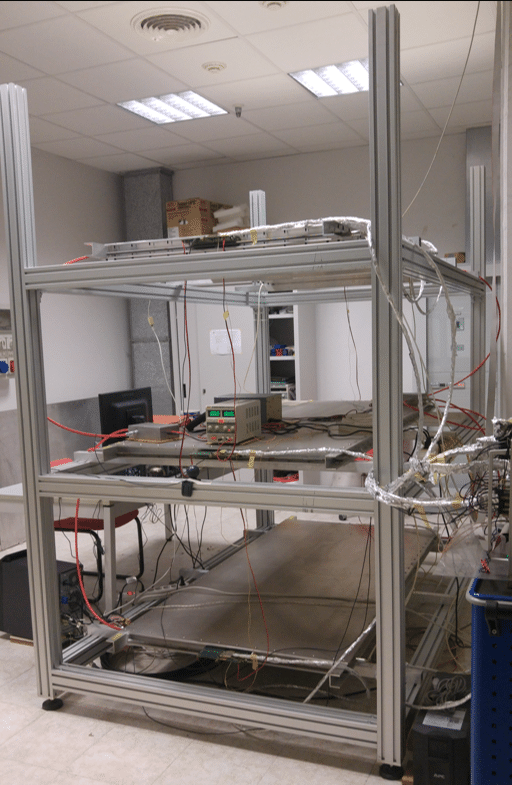
The EEE Project is a joint educational and scientific initiative by Centro Fermi (Rome) and INFN. The Project has built an array of cosmic ray detectors, installed in several Italian high schools. The goals of the Project include the study of the local cosmic muon flux, the detection of extensive air showers and the search for possible long range correlations between far detectors. A powerful impact on education is also envisaged by the EEE Project, which is strongly contributing to introduce a large number of school students to the problems and results of particle and astroparticle physics.
Development and application of cosmic ray tracking techniques
Faculty: D. Lo Presti, P. La Rocca
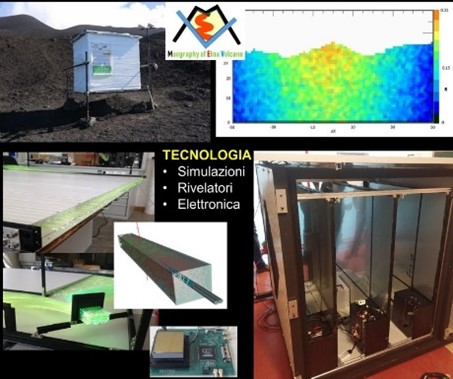
The MEV (Muography of Etna Volcano) project is funded by MIUR and Linea 2 it has allowed the development of cosmic ray tracking technologies for measuring the density map of the Northeast crater of the Etna volcano. International research agreement signed for joint activities with UniTokyo and Wigner RCP in 2019. In the PO-FESR 3DLab-Sicilia project, use case MONRAD, the use of cosmic ray tracking is envisaged for monitoring the stability of historic buildings.
