
Is noise always stochastic?
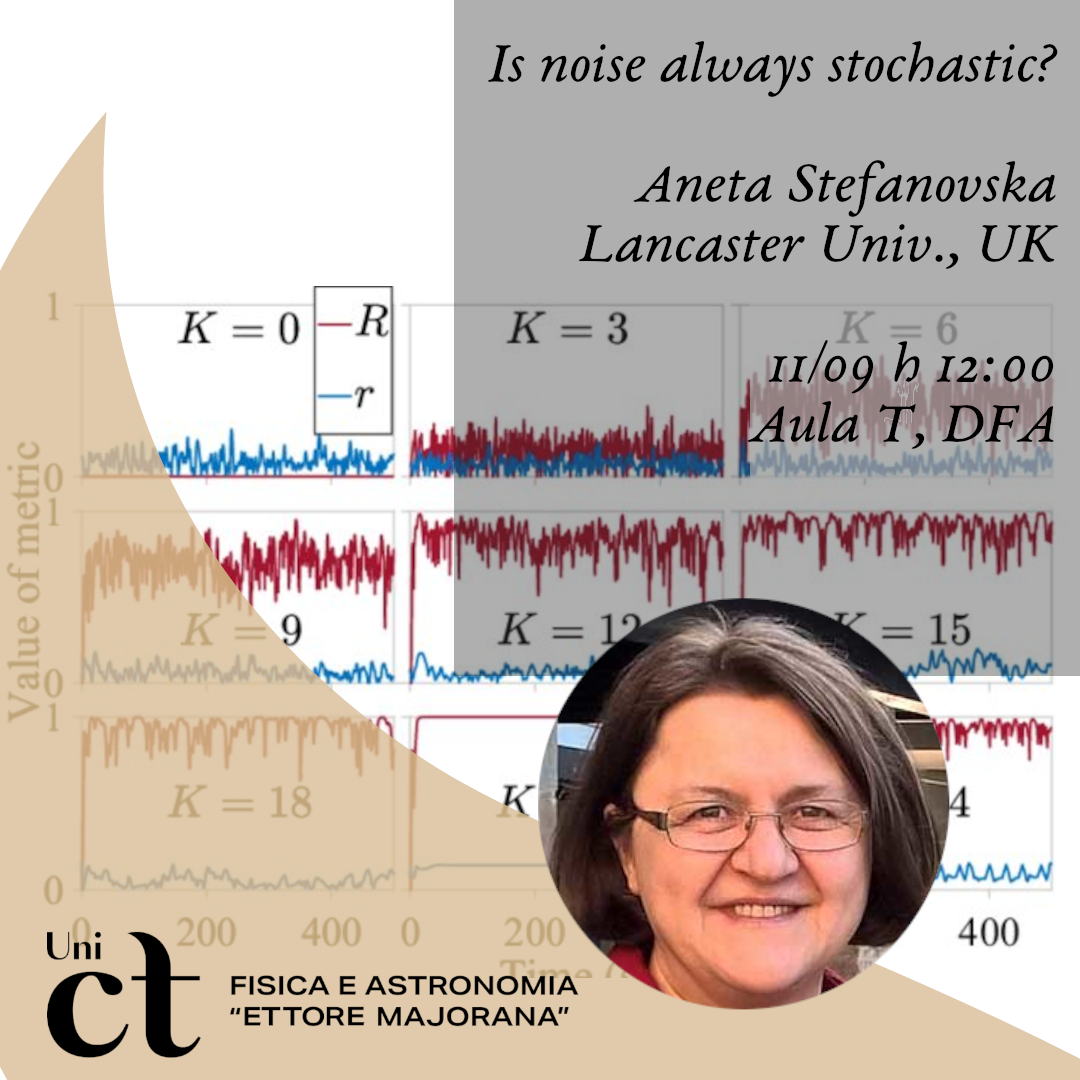
Giorno 11 settembre 2026, con inizio alle ore 12:00, presso l'Aula T del DFA, su invito del Prof. Andrea Rapisarda, la Prof.ssa Aneta Stefanovska (School of Physics and Astronomy, Lancaster University, Lancaster, UK) terrà un seminario dal titolo Is noise always stochastic?
Tutte le persone interessate sono invitate a partecipare.
Abstract. Noise is commonly associated with stochastic processes and is often invoked to describe variability that cannot be explained by deterministic models. This distinction between deterministic dynamics and stochastic fluctuations underpins much of modern physics, from statistical mechanics to stochastic processes and information theory. But is stochasticity always the most appropriate description of observed variability? Recent advances in the theory of non-autonomous dynamical systems suggest that some observations commonly modelled as stochastic may instead reflect deterministic, explicitly time-dependent dynamics. As our understanding of dynamical systems evolves, so too may the boundary between deterministic dynamics and stochastic modelling.
In this talk, I will revisit the role of noise from the perspective of non-autonomous dynamical systems. I will discuss how explicitly time-dependent deterministic dynamics can generate complex temporal variability while maintaining dynamical stability through continuously evolving attractors. Such systems do not converge to stationary states; instead, their stability is associated with trajectories that evolve in time, making temporal variability an intrinsic property of the dynamics rather than a perturbation of it.
Drawing on examples from nonlinear dynamics and physiology, I will show how concepts such as moving attractors, tracking stability, and chronotaxicity provide mathematical tools for describing and identifying this class of systems. The talk will conclude by discussing whether recent developments in non-autonomous dynamical systems call for a reassessment of the role of stochasticity in the interpretation of observed variability, and whether this represents one of the remaining unsolved problems of noise.
