
Lepton Number Violation in Nuclear Double-Charge-Exchange Reactions: A Novel Probe of Physics Beyond the Standard Model
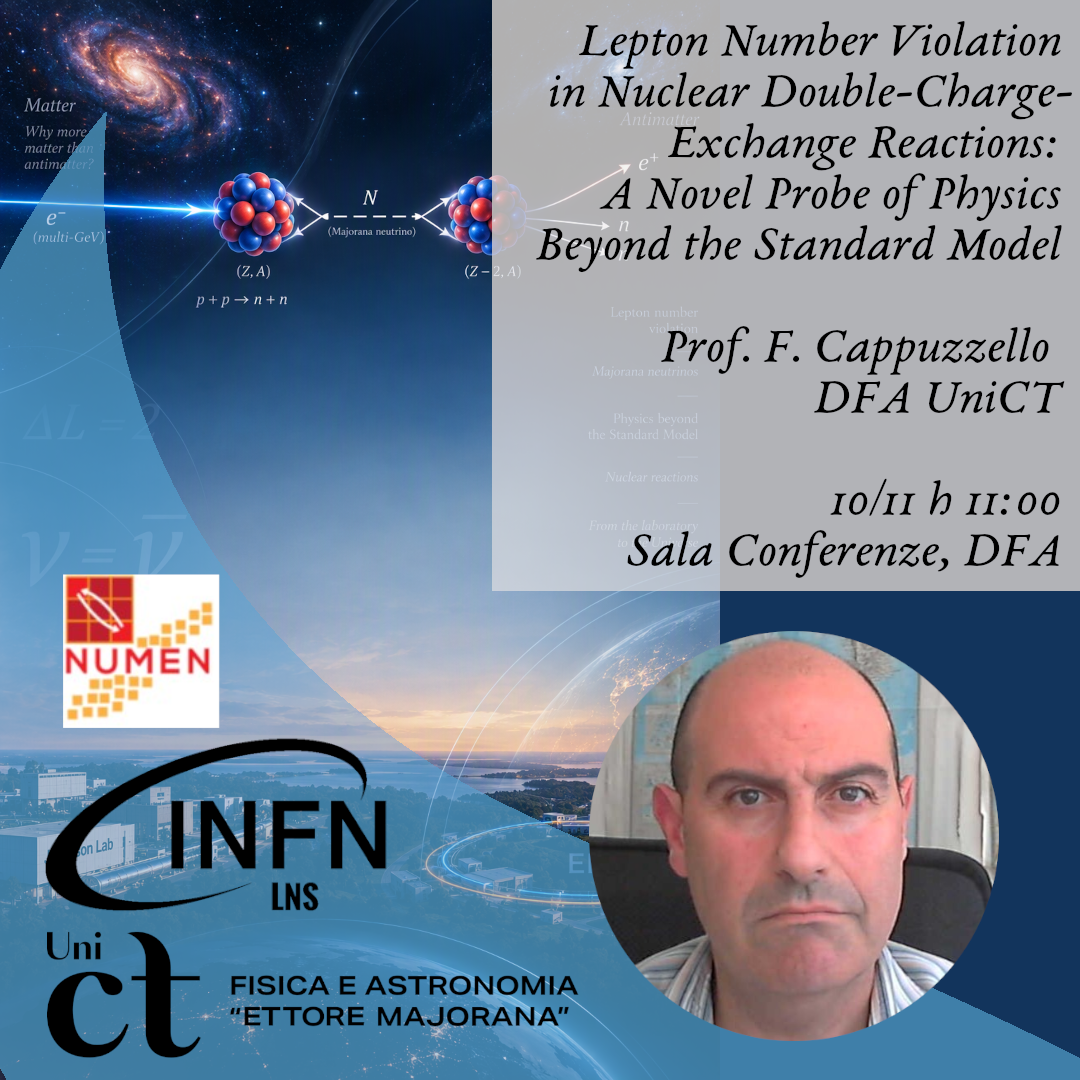
Giorno 10 novembre 2026, con inizio alle ore 11:00, presso la Sala Conferenze del DFA, il Prof. F. Cappuzzello terrà un seminario dal titolo Lepton Number Violation in Nuclear Double-Charge-Exchange Reactions: A Novel Probe of Physics Beyond the Standard Model.
Tutte le persone interessate sono invitate a partecipare.
Abstract. Lepton number violation (LNV) is a compelling possibility in particle physics, with profound implications for our understanding of neutrino properties and the origin of the matter–antimatter asymmetry in the Universe. The discovery of LNV would provide strong evidence for physics beyond the Standard Model and could establish the Majorana nature of neutrinos, offering important insights into the origin of their small masses. In this seminar, I will discuss a novel approach to probing LNV through lepton-number-violating double-charge-exchange (LDCE) reactions on nuclei induced by multi-GeV electron beams. Recently proposed as a potential probe of new physics, these reactions provide an alternative to conventional searches based on nuclear neutrinoless double beta decay or same sign dilepton and jet emissions in proton-proton ultra relativistic collisions at the Large Hadron Collider. I will present a second-order theoretical framework for describing the underlying LNV mechanisms within the left-right symmetric model (LRSM), together with a phenomenological approach to estimating the corresponding cross sections. The results indicate potentially sizable cross sections at multi-GeV beam energies, motivating further investigations of the experimental feasibility of this process. Finally, I will discuss the prospects for exploring LDCE reactions at existing accelerator facilities, particularly Jefferson Lab, and their potential future investigation at the Electron-Ion Collider (EIC). These studies may open a new experimental avenue for investigating LNV and exploring physics beyond the Standard Model under controlled laboratory conditions.